Friday, April 8, 2011

Lake Erie's Yesterdays

A part of the OhioLink Digital Media Center, the home page of Lake Erie's Yesterdays provides this description of its collection:

Lake Erie's Yesterdays is a collection of historic photographs of northwestern Ohio, documenting the local history of the Erie Islands and Lake Erie's western basin. These black and white images were produced by Sandusky, Ohio, commercial photographer Ernst Niebergall between 1909 and 1915.


Having grown up on North Central Ohio, Lake Erie is dear to my heart. Lake Erie's Yesterdays is searchable by keyword. You can also browse the collection by Place, Subject, or Creator.

Here are some of my favorite keyword searches:

Bay Bridge Train

wave

and

Cedar Point

If you have any ancestors who ever lived in or visited northwest Ohio, take some time to browse through these fabulous vintage photographs!


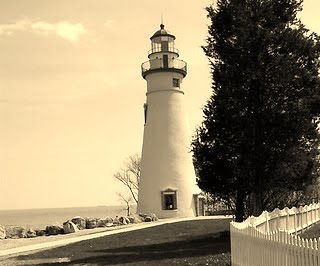
Note: The image of the Marblehead Lighthouse is not from Lake Erie's Yesterdays. The digital photo was taken in August of 2010, and the color was altered via Microsoft Windows Live Photo Gallery.

Thursday, April 7, 2011

Oh how I love my Kodak Easy Share!


Since 2006, I have been taking digital pictures with a Kodak Easy Share C703. Even though I am very much an amateur photographer, it is very simple to use. Most of the time I store my digital photos at Dropshots, a user-friendly sharing service that offers both free and premium accounts. Usually I just point and shoot. On occasion I use the close up setting on my camera. The tombstone for William Macrelli at St. Joseph Cemetery featured an image of young William.


With the close up setting, I was able to zoom in on the image, which shows a sweet young boy holding a kitten.


Before my blogging buddy, Terry Thornton, passed away, I was able to take a video with my Kodak Easy Share. I captured the band playing "Dixie" at the 100 Year Rededication Ceremony of the Bronze Monument to the Confederate Soldiers at Johnson's Island. It is surely not the most professional job, but I was able to send Terry the link of the band playing "Dixie." Click here to view the video on YouTube. Since my husband has many ancestors from the South, I have a soft spot in my heart for soldiers who served in both the North and the South during the Civil War. Terry always appreciated my fondness for Southern hospitality, which was so graciously shown us by Tom's aunts, uncles, and cousins in Georgia throughout our lives during our visits to the South.


For editing my digital pictures, I use both the Kodak Easy Share software, as well as the editing feature of the Windows Live Photo Gallery on my desktop computer. With the Kodak Easy Share software, I can fix red eyes, crop, change color and scene balance, and add text. I added text to the image below, to share the picture with my family and friends, and allow them to know the names of the Little Leaguers.


Another editing tool I use is the Spotlight feature, seen in the picture of the angel at the Perkins Cemetery, where my parents are buried.


The editing features in the Windows Live Photo Gallery allows me to straighten pictures, crop, fix red eye, and adjust exposure, color, and detail. In the picture of the Marblehead Lighthouse, I changed the color of the whole image to a sepia tone.


There is so much more that I need to learn about digital photography, but these are a few of the ways I use my beloved Kodak Easy Share!
Wednesday, April 6, 2011

Wednesday's Child: Macrelli Children

Between 1924 and 1929, Ferdinand and Mary (Zurma) Macrelli lost three children due to illness. The children are buried side by side at St. Joseph's Cemetery in Sandusky, Ohio. Census records tell us that Ferdinand and Mary were both born in Italy. They married in Erie County, Ohio on September 6, 1913. It is difficult to imagine the heartache that this couple faced together, in losing three children in such a short time span.

Alfredo Macrelli, called Frederick on his death certificate, died on November 22, 1924, at the age of 4 years old, due to heart disease. It looks as though a picture of Alfredo was once visible on his tombstone.


Rosa Macrelli died on August 30, 1925, at 6 years and 10 months of age. Her death certificate listed her cause of death as paralysis of heart.


A well worn image of Rosa can be seen on her tombstone.


The youngest of the Macrelli children, William, who was born on March 22, 1922, died on March 29, 1929, from peritonitis following acute appendicitis. He passed away only a week after his seventh birthday.


William's picture is still visible on his tombstone. The image shows William holding a kitten.


At the time the Macrelli family settled in Sandusky, there was widespread discrimination toward the foreign born population, including a lack of respect, and name calling. To have these social issues taking place at the same time as the loss of three beloved children is more than some families could handle. Two other daughters in the Macrelli family did survive to adulthood. I hope that the Macrelli family found solace in the Catholic church, as well as in the Italian American community that was very close knit in Sandusky for decades. Obituaries found in the OBITUARY NOTEBOOKS at the Sandusky Library indicate that the Macrelli family attended Saints Peter and Paul's Church.

Tuesday, April 5, 2011

Tombstone Tuesday: P.J. McGurty, Boilermaker


This small white tombstone is found in St. Joseph's Cemetery in Sandusky, Ohio, along with many other military tombstones. The inscription reads:

BoilerMaker
P. J. McGurty
U.S. Navy


An obituary for Patrick J. McGurty appeared in the April 25, 1905 issue of the Sandusky Register. The article said that Patrick J. McGurty served on the U.S.S. Bennington in the U.S. Navy during the Spanish American War. Mr. McGurty was admitted to the Ohio Soldiers' and Sailors' Home from Lorain County, Ohio on December 3, 1902. He died in the home's hospital on April 20, 1905. He had fallen down some basement stairs in Sandusky, and fractured his tibia and fibula. These injuries, complicated by "alcoholic excesses," led to his death. His remains were sent from the hospital to Sandusky for burial in the St. Joseph's Catholic Cemetery. In the U.S. Census for 1900, Patrick J. McGurty was residing in Lucas County, Ohio, and was employed as a boiler maker. He stated that his parents had both been born in the country of Ireland.

Monday, April 4, 2011

52 Weeks of Personal Genealogy and History: Spring


The prompt for Week 14 of 52 Weeks of Personal History & Genealogy, by Amy Coffin of We Tree, and hosted by Geneabloggers, is: Spring:

Week 14. Spring. What was spring like where and when you grew up? Describe not only the climate, but how the season influenced your activities, food choices, etc.

In Northern Ohio, Springtime brought warmer weather, after a long, cold winter. My mom began shopping for new Sunday clothes for the six children in our family, to be ready for Easter, and the boys (and Dad!) could hardly wait for baseball practice to begin! My dad is the last individual on the right in the picture below, taken at the ball park in Bay View, Ohio.


Spring also meant that dandelions would be popping up in lawns all around our village. That reminds me of the time I asked Grandma Emma to make me dandelion salad. I really wanted to like it! Here is the story of Grandma Emma's dandelion salad:

When I was very young, I heard that you could actually make a salad from dandelions that grew wild in the back yard. (Though I have a lot of farmers in my family tree, I did not have much experience with gardens or farms when I was little.) I thought I would ask my grandmother, Emma Yeager Orshoski, if it was true that a salad could be made out of dandelions. She assured me that it was true, and she said if I picked some dandelions, she would make a dandelion salad. So, I picked some dandelion greens, and I am sure that Grandma Emma also picked some. Before I knew it, Grandma had made the salad, and my dad took me down the road to Grandma's house so I could eat some of the dandelion salad. Grandma Em made it with a vinegar and oil dressing, and she also added chopped hard boiled eggs to the salad. I so wanted to love that salad....but I hated it! It was bitter, and wasn't anything like my mom's salad with iceberg lettuce and French dressing. I hope that my disappointment wasn't too obvious to Grandma Emma!It was so kind of her to take the time to make that special salad for me.

These recipes, found in a book entitled THE TABLE: HOW TO BUY FOOD, HOW TO COOK IT, AND HOW TO SERVE IT, by Alexander Filippini (C.L. Webster & Co., 1889),are accessible on Google Books. They sound similar to the dandelion salad my grandma made for me long ago.


Pictured below are my paternal grandparents, Steve and Emma Orshoski, with my brother and I, on Easter Sunday in the late 1950's.

Sunday, April 3, 2011

Piehl Family Lot in Union Cemetery


My great great grandparents, Ferdinand and Augusta (Jaensch) Piehl, and two of their children are buried in Union Cemetery in Salem Township, just outside Oak Harbor, in Ottawa County, Ohio. (Click on images to see a larger view.) Ferdinand and Augusta were both born in Germany,but came to the United States when they were still single. They were married at St. John Lutheran Church in Oak Harbor, by Rev. J. Bauch, on December 12, 1880. Early records sometimes list Ferdinand's first name as Gotthold or Gottlod. They had a total of nine children, the oldest daughter being my great grandmother Lena Piehl Yeager.


Here is a family picture of the Piehl family, taken about 1906.


Back row: Lena, Hulda, Christian, Emma, Martha
Center: Anna
Front row: Bertha, Ferdinand, Wanda, Augusta, Amanda


Ferdinand was a farmer, and he spoke only German. Amanda Piehl died on May 22, 1906, after contracting diphtheria. She was the first of the Piehl family to be buried in Union Cemetery.


Mrs. Augusta Piehl passed away on December 13, 1906. Her cause of death was listed as dropsy of chest.


The only boy in the family, Christian Piehl, died on March 4, 1913, at the age of 24.


Ferdinand Piehl died on September 17, 1927, of heart disease.


In 1995, I visited with Wilma Voight Hanck, the daughter of Emma Piehl Voight. She said that every summer there was a large family reunion at the Piehl farm. Aunt Bertha and Aunt Martha lived close by, and they always helped out. Wilma said there were enough cousins to have four baseball teams! There was a lot of delicious food, including thick homemade biscuits, and lots of visiting and family pictures were taken. Oh how I wish I could have gone to one of these reunions! After the death of Grandma and Grandpa Piehl, and their children began to have large families of their own, it seems that the tradition of the annual reunion ended.

Many thanks to cousins Al Hemminger and Fred Wargowsky, for helping me to learn more about the Piehl and Jaensch families.

Saturday, April 2, 2011

Albert W. and Julia Maag Schlesselman


Albert W. Schlesselman and Julia Maag Schlesselman are buried in the Kelleys Island Cemetery. Albert W. Schlesselman was born on September 21, 1876 to William and Mary (Barnhope) Schlesselman, at Kelleys Island, Ohio. According to Ohio Marriage Records, available at Family Search Labs, Albert W. Schlesselman married Julia Elizabeth Maag in November of 1903. Julia was the daughter of Daniel and Fredericka (Youngman) Maag. Sadly, Julia Maag Schlesselman died on June 15, 1906, when she was only 23 years old.

In August of 1907, Albert W. Schlesselman married Louisa Schnittker, the daughter of August and Amelia (Mayer) Schnittker. In the 1920 U.S. Census, Albert W. and Louisa Schlessman were living in Humboldt County, Iowa. They had a son and three daughters. Albert W. Schlesselman listed his occupation as Minister. By 1930, there were five Schlesselman children in the household, and Rev. Schlesselman stated that he was a clergyman in the Evangelical Church. In 1930, the family lived in Cresco, in Howard County, Iowa.

According to his tombstone, Rev. Albert W. Schlesselman died on December 29, 1948. He was buried next to his first wife Julia in the Kelleys Island Cemetery. At the top of the tombstone for Albert W. and Julia Maag Schlesselman is the inscription: "There is no night there."